




What is it really like to spend a year at a British boarding school? This time, Lilli tells us about her year at King’s School Canterbury, which she returned from in 2025. She talks about settling in, lessons and everyday life, making new friends and how the experience changed her. She also shares some advice for anyone thinking about going to boarding school themselves.
Hi Lilli! It’s great to have you with us. Could you briefly introduce yourself?
I’m Lilli, I’m 18 years old and I live near Düsseldorf. From 2024 to 2025, I spent a year at King’s School Canterbury. In my free time, I really enjoy cooking and baking, reading, going for runs and meeting up with my friends.
What made you want to go to a British boarding school?
I definitely wanted to go abroad and simply experience something different. I was also really interested in boarding school life: living closely with other people, learning and developing as a person. At the same time, I knew from the start that I’m very close to my family. So I couldn’t really imagine going as far away as America, Canada or Australia.
Why did you choose King’s School Canterbury?
I had a consultation with Mr Steinbeis. Originally, the plan was for me to go for just six months. He sent us a few boarding schools to consider, but also pointed out that there aren’t many schools that accept international students for just one or two terms. At the same time, he spoke very highly of King’s.
So in the end, that was actually the only school I applied to – I didn’t even look at any others. I simply said, “Okay, then I’ll go with this one.”
Looking back, I have to say that was pretty risky, because it also meant that King’s was the only school where I sat the entrance exam. It was only later that I realised it’s actually not that easy to get in. I wasn’t aware of that at all at the time. But I think it was probably a good thing that I went into it without any preconceptions and without really knowing what to expect from this whole world. I just went into it with an open mind.
Do you still remember your first day?
The school had put together a proper schedule for the first day. My parents drove me there in the morning and we went to the boarding house first. That’s where I met my housemistress and some of the other adults who worked in the house.
Then I joined the other girls from my house and we were shown around the school. They were all really open and immediately started talking to me – asking which A-levels I had chosen, where I lived and things like that.
That really helped me, because I wasn’t particularly outgoing myself at that moment. I was still quite overwhelmed by all the emotions. I had just said goodbye to my parents and knew, “I’m not going to see them again for three or four months. I’m here all on my own and I don’t really know anything yet.”
But the other girls being so open really helped. That’s why I don’t actually remember the first day as being particularly difficult. It went by incredibly quickly.
How did you manage with English at the beginning?
At first, I sometimes still felt a little unsure of myself. But there were hardly any Germans at King’s, so I simply had no choice but to speak English. From a language-learning perspective, that’s probably the best thing that can happen to you, because you adapt incredibly quickly.
And what was it like wearing a school uniform every day?
At first, I felt a little uncomfortable in it. It’s simply not the most flattering cut, and the skirts were quite long for my taste.
But you immediately feel properly dressed and somehow you’re straight into learning mode. And you don’t have to think at all about what to wear in the morning. That really is a big advantage.
And everyone looks the same. I think that makes you approach each other with fewer preconceptions. So socially, I think the uniform is a big advantage. And in the end, I didn’t actually think it looked that bad either. Above all, it was very practical.

Lilli and her parents ©LP

Lilli's boarding room with a fantastic view ©LP

First day at King’s School Canterbury ©LP
Let’s talk about school and lessons. How did you find the academic side of things?
First, I should probably explain which A-levels I took. I did French, which obviously didn’t require that much English. Then Maths, where communication was fairly limited as well, and History.
Maths and History were the two subjects where I sometimes reached my limits, both in terms of language and academically. I had actually chosen Maths because I thought, “Surely this should be manageable.” After all, it’s not about talking, it’s about doing calculations. But the differences between the German and British systems were much greater than I had expected.
Did you get any support?
Yes, there were lots of people you could turn to. We had tutor sessions, for example. I would sit with the girls from my boarding house who were in my year group, together with a teacher who gave us advice and helped us.
We also did homework every evening. If I had questions, I could go to whichever teacher was on duty in our house that evening. My friends helped me too. So there were definitely plenty of people to ask.
Maths was still a subject I didn’t particularly enjoy, though. Looking back, I probably would have chosen something else.
History was different. In the lessons themselves, I was actually fine with listening and participating. What I had never come across before were essays. We don’t really do anything quite like that in Germany. I found it really difficult at first to get the hang of them and to catch up in terms of language as well.
I managed it over time, but especially at the beginning there were situations when I felt completely overwhelmed and doubted myself. I think it’s also a bit unrealistic to imagine that you can simply move into a different school system without encountering any hurdles.
Was there a point when things started to get easier academically?
I was absolutely fine with French from the start. I had no problems at all. Maths, on the other hand, remained difficult right until the end. I just never really got on with the teaching style and the way the course was structured.
With History, that moment came in the second term. I wrote an essay that was really good. I was incredibly proud of it, and my teacher congratulated me and was genuinely pleased for me.
Then, in the third term, I sat the exam for one part of my History course, and that went really well too. I actually really enjoyed it. Those were moments when I felt genuinely proud of myself and realised how much I had developed academically.
What was a typical lesson like?
There were very few of us in each class, usually no more than ten. What the lessons were like depended very much on the subject. French was quite playful: lots of speaking, playing games, learning vocabulary and watching documentaries.
History was varied too. I had two different classes. In one, we sat in a U-shape and sometimes the teacher would spend almost the entire lesson telling us stories. I remember that in our very first lesson, he asked us all to close our eyes and then really drew us into the topic. It was almost like experiencing a history documentary live.
In my other History class, we did a lot of reading and discussing. I really enjoyed that as well. And in Maths, we simply did a lot of calculations and practice.
Because the classes were so small, you could get an incredible amount done in a single lesson. There was plenty of opportunity to discuss things and talk as a group. The lessons were generally very focused.
Did you have a lot of homework?
Every evening after dinner, we had Prep Time – basically homework time – until around 9 pm. Of course, you could get some of your work done at other times during the day, but sometimes there really was a lot.
Looking back, I wish I had approached it a little differently. I took everything very seriously, even though I wasn’t actually working towards my final school qualification in England. Sometimes I could probably have used my time more effectively for myself – by focusing on particular tasks or simply saying, “I’m exhausted now. I can’t do any more.”
Instead, I completely committed myself to the system. I often spent a long time on my work and sometimes felt quite desperate. But ultimately, I learnt an incredible amount from it.
That doesn’t mean I didn’t have time for other things or that I didn’t have an amazing amount of fun as well. But I’d be lying if I said it wasn’t academically challenging.

Special Commendation for the Model Arctic Council ©LP

The library - great place to study ©LP

What was life like after lessons? Which sports and activities did you try?
In my first term, I played lacrosse. I should probably say that I’m not exactly someone who’s particularly good at ball sports. But I still had a lot of fun doing it with my friends. I wasn’t aiming to be the best at it anyway. It was simply fun to try something completely new. I actually hadn’t even heard of the sport before.
In my second and third terms, I did cross-country, so basically running. I really enjoyed that. One of my close friends did it too, and it was much more relaxed. We met every afternoon and went for a run together.
Sometimes at the weekends, we went to the coast and did longer runs along the coastline. That’s actually how I discovered how much I enjoy running. I still do it today.
In the third term, I also did dance. Every year, our school has King’s Week, a whole week of performances and events. One of them is a big dance show, which I took part in.
What kind of performance was it?
The theme was “Musical Legends”, with lots of Michael Jackson but also some classical music. It was a mixture of ballet, hip-hop and jazz. It was quite a big production, with costumes and everything. It was really good fun.
Would you have taken part in something like that at your school in Germany?
No, definitely not.
What was different at King’s?
If a dance performance like that were offered at my school here, hardly anyone would probably take part. In Canterbury, there are so many people who are enthusiastic and interested and willing to put themselves out there. They’re constantly coming up with new ideas. I could try completely new things without feeling that it was somehow strange or that I didn’t belong. I really miss that. Being part of a community like that is incredibly fulfilling.
How did you make friends?
My closest friends were mainly the girls from my boarding house, simply because they were the people I spent the most time with and we could do lots of things together. Especially the girls in my year, of course. I also had two close friends from my classes.
There were all sorts of different people in my friendship group, not just in terms of where we came from, but also our personalities. Even so, we worked really well as a group. I’m still in touch with all of them.
Where were your friends from?
Probably my best friend is English. One friend is from Hong Kong, one from Nigeria, one has an English-French background, one is from Russia and one from Ukraine.
What was life like in the boarding house?
Before I went, I was really worried about having to share a room because I’d always had my own room at home and my privacy was very important to me. But in the end, I actually loved sharing a room. I lived in a different room each term and shared with a different girl each time. I got on well with my first roommate, and I became really good friends with the two I shared with afterwards.
We shared the bathrooms, which could sometimes be a little tiring with so many girls in one house. Noise could be an issue sometimes too. But overall, I really enjoyed living with my friends and being part of the house.
There were lots of house activities. One of them was the House Song. We all learnt a classic song from the 1970s together, a cappella, so without any instruments, and then competed against the other boarding houses. That was pretty cool.
The houses also competed against each other as teams in cross-country. That sense of competition between the houses was a big part of school life. It was fun.
What did a typical weekend look like for you?
On Saturdays, we had a few lessons first. After that, we had Games, so our sports activities. We were free in the afternoon. I might go into town, cook something or simply spend time with my friends.
A few times, my friend invited me home with her, so I stayed with her in London. That was really lovely. I really came to love London.
Did you ever break the rules a little?
Of course. If we had a formal dinner, for example the Christmas Dinner, we didn’t necessarily stick to just one glass of sparkling wine. But personally, I never felt so restricted that I had a real urge to break the rules.
I did get into trouble once because I’d painted my fingernails red. I tried to hide them behind my book, but that didn’t work particularly well. I had to remove the nail polish there and then. I found that pretty annoying. But I took it off, and that was the end of it.
What was your relationship with the houseparents like?
My housemistress tried to get to know each of us a little, but she tended to stay in the background because she was also a teacher and had two young children.
I liked the fact that she always had a few kind words for us in the evenings. She wasn’t necessarily the warmest person, but she was someone you could talk to and someone who reliably took care of things. If I needed help with something practical or anything else, she was always there.
I also got on very well with the tutors assigned to our house. They didn’t live there, but they were often around.
Was there someone you could turn to if you were having a bad day?
If you weren’t doing well, the people in the house definitely noticed and tried to talk to you or support you.
Especially at the beginning, I went to my housemistress quite a few times and told her that I was completely overwhelmed. At that point, I was still taking a fourth A-level. Eventually she said, “You’re just going to drop that one now and concentrate on the other three.” She also spoke to my teachers and explained that I was struggling a bit and should be given less homework for a while so that I had more time to look after myself.
We also had our matron, who took care of medication. If I had a headache or something else was wrong, I went to her and she always looked after me.
Overall, we were really very well looked after.
Were there ever any conflicts?
Of course, there were occasional conflicts within our house. A house full of girls of different ages, all sharing a kitchen – it’s inevitable that there will be disagreements from time to time.
For example, we could buy our own food and keep it in the kitchen. You would write your name on it, but every now and then things still disappeared. And when it’s your food, that’s obviously annoying.
We usually sorted out those smaller conflicts among ourselves. Sometimes our housemistress would step in as well. So during the evening rollcalls, there would occasionally be a few words about whatever had happened. Her role definitely involved setting boundaries and guiding us.
I didn’t really experience any major conflicts myself. But I did notice that the school offered lots of opportunities to talk about problems. There was a Wellbeing Hub, for example, and regular surveys asking how things were going and what could be changed or improved.
That probably also meant there wasn’t much opportunity for conflicts to grow into something bigger. Most of the time, it was just the ordinary little interpersonal issues that you have to learn to sort out together.

Lilli at Lacrosse training ©LP


You just mentioned the food. What did you think of it?
My biggest problem was actually breakfast, because I really didn’t like the typical English breakfast. So breakfast wasn’t particularly enjoyable for me.
For lunch and dinner, on the other hand, there was quite a lot of choice: meat, vegetarian dishes and a salad bar. Of course, the quality wasn’t the same as at home, but you got used to it pretty quickly.
We could also cook for ourselves. We could buy food at the supermarket, keep it in the kitchen and prepare it there. At weekends, we were also allowed to order food or go out to eat in Canterbury. So we were relatively flexible.
I usually thought lunch was really good, although I liked some of the dinners less. But from everything I heard from other people as well, I’d say the school had a pretty good canteen.
How comfortable was your boarding house?
Many of the boarding houses at King’s are old, and some are listed buildings. From the outside, they look incredibly impressive, although our house wasn’t quite as nice inside. I had very basic windows, for example. But it was never cold, and the rooms were fine. Mine were always spacious.
Some of the boarding houses were more modern. One thing I found interesting was that when students leave King’s, their connection with the school often doesn’t end there. Many remain part of the community and later support the school financially. Some of that funding also goes towards boarding houses, which means that some are more modern or better equipped than others.
I was in the oldest house, though. And there was something special about that too.
Did you ever have a real low point?
Yes, I think that was definitely at the beginning. During the first few weeks, there were times when I thought, “How am I ever going to enjoy myself here?” I felt very trapped and overwhelmed.
I didn’t know whether I would really find close friends. That was definitely a low point.
And then there were periods when I was really stressed because of the workload.
What would you do differently if you could start your boarding school experience again tomorrow?
I would be much more open with people, take more initiative from the very beginning and get involved more.
And I wouldn’t put myself under so much pressure about homework and schoolwork. I might choose different subjects as well. I definitely wouldn’t take Maths again!
Those are probably the main things I would do differently.
How did the year change you?
I definitely became much more confident, more spontaneous and more adventurous. I do things now and have the confidence to try things that I wouldn’t have done before.
Can you give us an example?
You can actually see it in the way I approach things in general. I’m more likely to volunteer for things and try something new.
Recently, for example, I gave a speech in my local town as part of a commemoration event. I would never have done anything like that before. I would immediately have said, “No, that’s too much for me. I can’t do that.”
I’ve simply become more open and active, and I talk to people more. At the same time, my interests have become more defined. I’m much more passionate about certain things than I was before.
The year also helped me work out what I want for my future.
Did your plans for the future change during your time in Canterbury?
Not dramatically. I already knew that I was interested in history, society and politics.
But in England, for example, I took part in MUN, a simulation of a UN conference for young people. Everyone represents a country on a particular committee. In my case, we simulated the Arctic Council. We looked at how different countries can use the region, resolve conflicts, address climate issues and involve indigenous communities. I found that really interesting.
I also really enjoyed History. I’ve now chosen it as one of my advanced subjects back in Germany.
And I realised how much I benefit from learning in small groups. So later on, I’d like to find a university that offers something similar and also does a lot of teaching in small groups.
Are you glad you decided to stay for a whole year?
Yes, by the end I had enjoyed the year enormously. Looking back, that’s also why I think it was so important that I stayed for that long. If you only stay for one or two terms, you don’t really get the chance to make the most of the experience.
If I’d had to go home after the second term, I would have really regretted it. So my advice to anyone considering it would be: even if at first you think six months sounds much better because a whole year seems so long – do the year. I’m very glad I listened to Mr Steinbeis’s advice at the time and decided to go for it.

Lilli's friends visiting Düsseldorf ©LP

The Cathedral of Canterbury is based on the school grounds ©LP

Looking back now, what was your favourite moment?
It’s difficult to pick just one. In the final term, for example, some of my favourite moments were simply sitting in my room with my best friend and talking.
I also always found it really rewarding when I was able to make a good contribution in class.
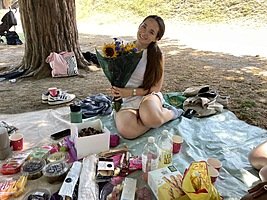
During our last few days, we organised a farewell picnic. That was another moment when I really felt that I belonged and realised what wonderful friends I had made there. And I also realised that it wasn’t a case of, “I’m leaving now and that’s the end of it.” I’m still in touch with everyone and see them regularly.
What advice would you give to someone who is considering going to a British boarding school?
First of all, try to get to know as many people as possible. Be open to others and don’t be afraid.
Try as many things as you can. Especially if you’re coming from Germany, you probably won’t often find yourself in a place again where you’re offered so many first-class opportunities as you are at schools like these.
And when packing, I’d take things that help turn your room into somewhere you really feel at home. I brought two cuddly toys, my favourite bed linen and lots of little photos and postcards.
Thank you so much, Lilli, for these wonderful answers and for giving us such a personal insight into your life at King’s. We wish you all the very best for the future.


