


Our Articles • 23rd July 2026
A Year Abroad in England - A Transformative Experience!
A year abroad in England is about far more than lessons in English. It is often the small moments that students remember years later: the first breakfast together in the boarding house, lively discussions with classmates from around the world, rugby training in pouring rain or the spontaneous applause after a theatre performance. These are the experiences that turn a school year abroad into something that goes far beyond learning a language.
What Are the Benefits of a Year Abroad in England?
Of course, spending a year abroad also improves a student’s English almost automatically. More importantly, however, it gives young people a new perspective. They learn to find their way in an unfamiliar environment, build friendships across national borders and become more independent step by step. Especially now, at the end of the school year, many parents tell us that their children have returned more mature, more confident and noticeably more open-minded.
England, the USA, Canada, New Zealand or a Host Family: Which Option Is Right for My Child?
There are, of course, many ways to spend time abroad. Some families choose a high school in the USA, Canada or even New Zealand, while others opt for a stay with a host family. Each of these options has its own strengths. British boarding schools, however, differ in one important respect: teaching, extracurricular activities and pastoral care are closely connected, creating a community that extends far beyond the classroom.
Why So Many Families Choose a Boarding School in England
For decades, England has been one of the most popular destinations for a school experience abroad – and with good reason. Its schools combine academic excellence with an exceptionally wide range of opportunities beyond the classroom. Whether it is sport, music, drama, debating or robotics, for many students the part of the day they look forward to most begins when lessons have finished.
In this article, we show what a year abroad in England is really like, what everyday life at a British school feels like and why so many families say that a year in England changes far more than they ever imagined.


photo courtesy of Stonar School

Everyday Life at a Boarding School in England: Lessons, Sport and Free Time
Anyone visiting an English boarding school for the first time quickly notices one thing: life does not take place only in the classroom. Of course, lessons are academically demanding and pupils are expected to work hard. At the same time, many British schools take a much broader view of education. Although lessons finish in the afternoon, the school day is far from over.
Once classes have ended, pupils head off to the sports fields, the music school, the theatre or one of the many clubs on offer. While some are training for Saturday’s hockey match, others are rehearsing with the school orchestra, building robots for the next competition or preparing for a debating tournament. Others discover something completely new, from clay pigeon shooting and surfing to film production or street dance. At many schools, activities change each term, giving pupils the opportunity to explore new interests throughout the year.
Sport at English Boarding Schools: From Rugby to Riding
Sport plays a particularly important role. Rugby, hockey, cricket and rowing are just as much a part of everyday school life as football, tennis, riding or swimming. Many schools have outstanding sports facilities and compete regularly in regional and national competitions. At the same time, not everyone is expected to be a high-performance athlete. Pupils who simply enjoy being active will also find their place, whether through yoga, climbing or a running club. Commitment is often recognised, for example with a Sports Tie – a special tie awarded in recognition of sporting achievement and dedication to the school team.
Music, Drama and Clubs: Discovering Talents Beyond the Classroom
Creativity also has a firm place in school life in England. Choirs, orchestras, theatre productions and art projects are a regular part of the annual programme at many schools. Some boarding schools even have professional theatres, dance studios or dedicated Steinway music centres. For many pupils, these experiences create memories that last long after they have left school, whether it is performing a first solo on stage, taking part in a concert or working behind the scenes on a theatre production.
It is this variety that makes the difference. School does not end with the final bell. It becomes a place where children and young people discover new talents, take on responsibility and often develop interests that stay with them for the rest of their lives.


The school's stunning chapel
Boarding and Pastoral Care: Why Children Become Independent So Quickly
Before their child leaves, most parents have one question above all: How will my child cope without us? Experience shows that, in most cases, much more quickly than they themselves expect.
Life at a boarding school follows a clear daily routine. The day begins with breakfast together, followed by lessons, sports or music. Afterwards comes prep, before the day ends with shared activities or simply a relaxed evening in the boarding house. This structure provides a sense of security and is particularly helpful for pupils who are away from home for the first time.
This is also one of the key differences between a boarding school and a stay with a host family or many high schools in North America. While everyday life there is shaped more by family life or the individual school, boarding pupils spend their entire day together on campus. As a result, friendships often develop very quickly, and for many students the strong sense of community becomes one of the defining experiences of their year abroad.
Why a Year at Boarding School Helps Children Become More Independent
Almost without noticing it, pupils learn to take responsibility for themselves. They organise their daily routine, pack their sports kit, keep their rooms tidy and manage their time between lessons, hobbies and friends. Many parents tell us that after a year abroad their children return home noticeably more independent and suddenly take care of things that previously required countless reminders.
Pastoral Care: Understanding the British Support System
A key part of this experience is what British schools call Pastoral Care. This typically British concept goes far beyond academic support. Houseparents, tutors, teachers, school nurses and chaplains work together to form a close support network that accompanies pupils throughout their daily lives. Whether a student is feeling homesick, needs help with schoolwork or simply wants someone to talk to, there is always somebody ready to listen.
The aim is not to replace parents. Instead, schools create an environment in which children can gradually become more independent without ever feeling left on their own. It is precisely this combination of growing independence and reliable support that makes boarding at a British school so special for many families.


Super cozy: boarding house School House's living room at Brighton College


Typically English: Chapel, Cadets and British Traditions
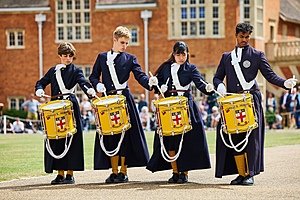
Anyone visiting an English boarding school for the first time is likely to come across traditions that may initially seem unfamiliar to German families. School uniforms are just as much a part of everyday life as Prefects (older pupils who take on responsibility) or the morning assembly attended by the whole school. Many of these traditions date back centuries and continue to shape school life today.
The Chapel: More Than Just a School Chapel
At many boarding schools, the Chapel also plays an important role. Even at schools where religion is not a central part of everyday life, it regularly hosts assemblies, concerts and short services. For many pupils, the Chapel is less a place of worship than a place where the whole school community comes together. The historic chapels at many boarding schools are particularly impressive, such as the magnificent Gothic Revival Chapel at Lancing College, which resembles a cathedral far more than a typical school chapel.
What Are Cadets? Understanding the Combined Cadet Force
The Combined Cadet Force (CCF) often raises questions among families at first. In reality, however, it is not about military training but about teamwork, responsibility and leadership. Through field exercises, navigation challenges and shared projects, pupils learn to work together, overcome challenges as a team and take responsibility for one another. Many students therefore describe the CCF as one of the most memorable parts of their school experience.
How British Traditions Help Young People Grow
As different as these traditions may seem, they all share the same purpose. British schools aim not only to provide an excellent education but also to prepare young people for life. Taking responsibility, contributing to a community, discovering individual talents and challenging oneself are considered just as much a part of school life as mathematics or English. It is precisely this combination of tradition and personal development that gives many English schools their distinctive character.


Discover England: Summer Schools, Work Experience and the Differences Between England, Scotland, Wales and Northern Ireland
A full academic year is not the right choice for every family. Those who would first like to find out whether a British boarding school is the right fit can choose from a range of shorter programmes or taster sessions, often during the school holidays or for a few days during term time. Summer Schools are particularly popular because they offer a first insight into life on campus: lessons in the morning, sports or creative activities in the afternoon, and excursions at weekends. For many pupils, this is the moment when a vague idea turns into a genuine ambition. If you would like to learn more about the advantages of spending one, two or three terms abroad, you can read our article here.
Work Experience and Academic Programmes for Older Students
Older students can also benefit from spending time in England. Some schools offer programmes with a clear career focus, for example in medicine, business, journalism or preparation for applications to highly competitive universities. These programmes are about much more than theory. Practical projects, presentations and insights into different professions help young people discover their interests and gain confidence about their next steps.
England, Scotland, Wales or Northern Ireland: Which Region Is Right for My Child?
Families considering a school experience in the United Kingdom should not focus solely on England. Scotland, Wales and Northern Ireland are all part of the UK, yet each has its own distinct character. Scottish boarding schools are often set in spectacular surroundings and offer exceptional opportunities for Outdoor Education, golf, sailing and expeditions. Northern Ireland is known for its strong sense of community, good accessibility and, in many cases, excellent value for money. Wales, meanwhile, is often overlooked but offers schools surrounded by nature, with excellent sporting opportunities and a particularly personal atmosphere.
Ireland, by contrast, is not part of the British education system. Its schools can also be an excellent choice, but they follow their own curriculum and qualifications. For this reason, it is worth taking a closer look at which country, education system and length of stay are the best fit for your child. In the end, it is not simply the name of the school that matters, but whether the environment, pastoral care, subject choices and everyday school life are the right match.


photo courtesy of Bryanston School
Is a Year Abroad in England the Right Choice? Our Conclusion
A year abroad in England is about far more than improving your English or achieving good grades. It is the experience of finding your way in a new environment, building friendships with people from all over the world and becoming a little more independent every day. Whether in the classroom, on the sports field, on stage or in the boarding house, students gain experiences that extend far beyond everyday school life.
Choosing the Right School Matters More Than Choosing the Most Famous One
Of course, not every school is the same. Some place a strong emphasis on sport, others on music, science or Outdoor Education. That is precisely why it is worth taking a closer look and choosing a school that matches your child’s personality, interests and strengths.
Whether a boarding school in the United Kingdom, a high school in the USA or Canada, or a stay with a host family is the right choice always depends on the individual child and the expectations of the family. There is no single answer that suits everyone. What matters most is finding the programme that best matches your child’s goals, interests and needs.
