



Our Articles • 28th October 2026
Sidcot School: Between Horses, Art and Strong Values

Introduction
Silver trainers and orange-painted fingernails at a British boarding school? Not quite what you would expect, is it? Neither did we, when we visited Sidcot School, south-west of Bristol, some time ago and encountered a few Sixth Form students dressed rather casually. What initially appeared to be an eccentric school full of free spirits turned out, over the course of our visit, to be something quite different. Sidcot is not only a school where artistic expression is particularly encouraged – it is also a Quaker school.
Values That Make a Difference
What this means for everyday school life, and how Quaker schools differ from other British boarding schools, became clearer a little later when we spoke to Headmaster James Jones. He explained how equality, a strong sense of community and integrity are deeply rooted in the school’s core values. Sidcot has also been a designated “Changemaker School” for the past ten years, encouraging students to take responsibility, develop their own ideas and initiate change. Together, these principles form a remarkably strong foundation of values, and we were curious to see how they translated into everyday life.
A Tour with a Twist
We got a good sense of this when we set off on a tour of the school with Fidelia and John, our student guides. Relaxed, open and with a friendly self-confidence, the two Sixth Form students chatted away in German and English about everyday school life as they showed us around the boarding houses, cafeteria and teaching buildings, including a bustling art studio. Our final stop was the equestrian facilities, where John simply remarked with a wry smile, “The Germans and their horses!” There certainly seems to be a special connection.
Once You’re Here, You Stay
We then learnt more about life beyond the classroom from Ailsa, the International Coordinator, who gave us an insight into everyday boarding life. And finally, we joined the entire Admissions Team for a feast at the buffet. The ladies in Admissions, incidentally, know Sidcot better than any school prospectus ever could. One of them has been working at the school for 23 years. Her comment? “Once you’re here, you stay.”
And apparently, that doesn’t just apply to the staff. Some of our students originally came to Sidcot for just one term, only to extend their stay to two or three terms – or even longer.
Sidcot, then, is a school that’s well worth a closer look. Come along and see for yourself!


The Location
Sidcot is located in beautiful Somerset, one of those British counties whose rolling green hills, hedgerows, sheep and little villages look as though they belong on a postcard. For us, this meant a three-hour train journey from London via Bath, changing trains in Bristol – two lively university cities not far from the school and therefore popular destinations for excursions.
Getting There
Those travelling by air may be lucky enough to fly into Bristol International Airport, just 15 kilometres from the school. Unfortunately, “international” in this case means that only a limited number of routes are available to and from Germany, Austria and Switzerland. So it’s worth checking carefully beforehand. Alternatively, the school offers a transfer service from London Heathrow Airport, making it possible to reach Sidcot from there in around two hours.
A Supermarket Within Walking Distance!
The boarding school, with its 455 pupils in the Senior School, is situated in a rural setting on the outskirts of Winscombe, a rather unassuming village with two supermarkets, a chemist’s and a café. Yes, we stand by our view: a supermarket is essential to the happiness of boarding school students! And when it’s within walking distance, as it is at Sidcot, that’s definitely a bonus.
A Campus with Character
While other British boarding schools hide behind high walls and imposing historic façades, Sidcot presents itself as open yet understated. The simple white main building, with its traditional sash windows, has an air of history without being pretentious. It was built as a Quaker school back in 1808.
And although the school stands in an impressive 160 acres of parkland – roughly twice the size of the Oktoberfest grounds in Munich – most of the boarding houses and teaching buildings are close together. This gave us the impression of a compact campus, which certainly has its advantages on rainy days.


Plenty of Space for Sport
This leaves plenty of room for sports facilities: a 25-metre indoor swimming pool, a large sports hall, four tennis courts, an artificial hockey pitch, another for rugby and football, and extensive grass playing fields. All the facilities are well maintained, although Sidcot is certainly not a traditional sports-focused boarding school!
A Paradise for Horse Lovers
One sporting facility that really stands out, however, is the Equestrian Centre. Alongside the large floodlit riding arena, which we visited, there is, of course, the wonderful opportunity to explore Somerset’s beautiful countryside on horseback. And it wasn’t just our team’s equestrian expert, Dorothee Hawkins, who was impressed by the facilities. Several of our students have extended their stay at Sidcot and even brought their own horses over from home.
Art Around Every Corner
What Sidcot may lack in outward grandeur, it more than makes up for inside. “Everything you see at Sidcot in terms of art has been created by the students themselves,” Ailsa told us. The corridors were filled with paintings, sculptures, student-designed clothes and installations.
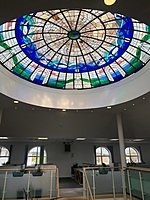
We discovered perhaps the most impressive work of art in the Trevelyan Library: a stained-glass dome, around three metres in diameter, cast colourful light onto the bookshelves and tables below. “The students made the dome,” John remarked, and his pride in the high standard of artistic work at Sidcot was unmistakable.
A Library Worth Lingering In
The library itself is one of those places, alongside the boarding houses, where you could happily spend hours. Warm and welcoming, modern, spacious and pleasantly quiet, it offers an ideal environment for reading and studying. Upstairs, there are additional rooms for students who want to work in pairs, as well as small study booths for those who prefer to shut out the world completely while they concentrate.
A Sixth Form Centre Shaped by Students
Just behind the library is the Sixth Form Centre, a good example of how Sidcot puts its Changemaker values into practice. Students had a say in designing the space, and it offers everything they need to enjoy their free periods, from table football to comfortable seating areas and dedicated study spaces.
Fidelia certainly feels at home here: “We all get on so well as a year group that we spend a lot of time together and even have dinner together in the evenings.”
Good Food – and a Say in What’s Served
And as we discovered for ourselves a little later, the food in the bright, open-plan dining hall really was delicious. “That’s because we have a committee with student representatives, so we’ve been involved in developing the menu,” John explained.
This may also explain the surprisingly generous selection of vegetables and salads on offer. Those more interested in pizza and snacks can head to the adjoining café, an inviting space where students can also work. A pretty good job, according to Fidelia. After all, you’re right where the food is – and you get paid for it too.


What Makes Sidcot Special – In Our View?
The Quaker tradition certainly sets Sidcot apart, and during our visit, we were struck by the school’s friendly, down-to-earth atmosphere, its social commitment and the respect shown towards others.
A Boarding School You Can Try Out
Sidcot also offers students the opportunity to try boarding school life before committing to a longer stay. They can enrol for just half a term to find out whether the school – and particularly its riding facilities – are right for them.
And this really is something special: bringing your own horse to boarding school and stabling it right on campus is far from common, even among British boarding schools. For students who come without their own horse, especially for a shorter stay, and want to ride intensively, Sidcot is an excellent choice.
A Place for Young Artists
Sidcot should also be on your shortlist if you’re looking for a school where you can develop your artistic talents. The studios, the quality of the work and the sheer number of pieces on display spoke for themselves.
Students Who Want to Stay
Finally, Sidcot ranks particularly highly with us when it comes to student satisfaction. Every single student we placed at the school last year extended their stay!
The reasons undoubtedly vary. But John summed it up perfectly during our visit: “One of the reasons you come to this school is definitely the sense of community.”


Academics
Before we get to the latest exam results, let’s take a brief detour. When it comes to academics, most British boarding schools are in fierce competition with one another, constantly looking for the best ways to help their students achieve their potential. After all, good exam results also influence a school’s future popularity. To this end, schools invest in technology, modern classrooms, tutors and extra tuition, while experimenting with a wide range of subjects and teaching methods. And rightly so.
One aspect of learning that is easily overlooked, however, is the feeling of security. Students who feel supported and accepted by their classmates and teachers are more likely to have confidence in their abilities, participate actively in lessons and, as a result, learn more and push beyond their perceived limits.
Headmaster James Jones explains that relationships between students and teachers at Sidcot are informal and that the school’s approach to education is more open than at many other schools, while remaining firmly rooted in mutual respect.
A Moment of Silence
This is particularly evident during the weekly assemblies. “They begin in silence, and sometimes there is a short prompt, perhaps a phrase such as ‘stand up for friends’. Anyone who wants to can stand up and share their thoughts with the others. Those who prefer not to speak simply remain silent,” James Jones explains.
He and the other teachers sit among the students – quite literally on the same level.
Good Results Without the Pressure Cooker
In keeping with this philosophy, Sidcot does not have the intense academic pressure found at some other high-achieving boarding schools. It is not one of those schools that select students primarily on the basis of their grades and subsequently boast impressive examination statistics. Instead, Sidcot welcomes students with a wide range of academic abilities.
Against this background, the results are all the more respectable. In 2025, 29 per cent of GCSE grades were at levels 9–7. At A-Level, 32 per cent of grades were A*/A, while 55 per cent were A*–B. In the International Baccalaureate, Sidcot achieved an average of 33 points, above the global average of 30.9.
Individual Support, Small Classes
Of course, Sidcot also focuses on effective learning strategies and helping students achieve their best. In the Sixth Form, classes have an average of just ten students. There are also 15 minutes in a tutor group every day, with additional individual support available whenever needed.
And sometimes, support simply means having more teachers. “I have three Spanish teachers: one for grammar, one for Latin America and one for exam preparation,” John tells us.
When things get too stressful, students can retreat to the Wellbeing House. It offers a quiet place to relax when exam pressure builds up or to get on with homework without distractions.
From GCSEs to Fashion Design
Students who join Sidcot at 14 or 15 and take their GCSEs here can choose from a broad range of subjects. Alongside the traditional academic subjects, options include Photography, Design Technology, Drama, Music and Textiles, as well as opportunities to improve their cooking skills.
Textiles, in particular, seems to be a favourite. As we walked along a corridor, a group of girls passing by simply called out to us: “Textiles is really nice!”
The subject covers fashion and textile design, including fabric printing and dyeing, embroidery, felting, weaving, knitting and crochet, as well as pattern cutting, fashion illustration and making complete garments. The highlight is a fashion show at the end of the school year.
Silver Trainers – But Not Every Day
We’re fairly sure that all this textile creativity has rubbed off on Fidelia’s silver trainers. But Sidcot has its traditional side too, and even here, some classic British school customs remain firmly in place.
Students wear a uniform up to and including Fifth Form. Only Sixth Form students are allowed to express their own style, and even then, only from Tuesday to Friday. Mondays call for “formal business wear”, while Thursdays are sports days, when everyone comes to lessons in their sports kit.
Art Beyond the Classroom
The range of creative opportunities at Sidcot is strikingly broad. What stayed with us most, however, was the art.
The ceramics studio was full of IB and A-Level students working with concentration in a friendly atmosphere. It was clear that they spend far more time here than their timetables require.
The same was evident in the IB final exhibition in the foyer, where elaborate pieces were on display that could easily have found a place in an art gallery.
There are also occasional special projects and trips, such as creating an art installation for the famous Glastonbury Festival two years ago, or a trip to New York for Drama and Art students.
Smartphones: Not Seen, Not Heard
A final word on Sidcot’s mobile phone policy. The school accepts that smartphones are part of everyday life, but they should not interfere with learning or social interaction.
Up to and including Fifth Form, phones must therefore remain at home or in the boarding house during the school day. From Sixth Form onwards, the rule is simple: “Not seen, not heard.”
Anyone caught using their phone without permission between 8 am and 6 pm has to hand it in until the end of the school day.


Beyond the Classroom
Outside the classroom, Sidcot offers a wide range of activities and – surprise! – is particularly strong in the creative arts. Those looking for an extensive selection of academically focused clubs and societies, such as science or debating, however, will find somewhat fewer options here.
Music, Drama and a Little Extra Matilda
The Music and Drama departments are also well equipped. The school has its own Music School with a concert hall, practice rooms, a recording studio and a room for digital music production. Alongside individual instrumental lessons, students can join a Jazz Band, String Ensemble, orchestra, various choirs or a Music Tech Club.
And music and drama at Sidcot certainly don’t just exist on paper. During our tour, they were quite literally impossible to miss: singing lessons were taking place behind one of the doors, while John and Fidelia spoke enthusiastically about the school musical, Matilda.
“So many students wanted parts in Matilda that extra lines were quickly written to make sure as many as possible could get on stage,” John told us.
Those wishing to take drama further can attend LAMDA lessons and prepare specifically for examinations set by the London Academy of Music & Dramatic Art.
From Cricket to Ultimate Frisbee
The sports programme covers the traditional favourites, from football, cricket and tennis to triathlon training and netball. Things get a little more unusual with Ultimate Frisbee.
The standard of hockey is particularly high among the older girls. “There isn’t a beginners’ team for Year 12,” Fidelia explains.
The school has also recently partnered with the Bristol Flyers basketball team to offer professional coaching. This includes 5.5 hours of training per week with the U18 team, competitive matches and targeted strength and conditioning sessions in the newly equipped gym.
Elsewhere, things are a little more relaxed. The swimming pool isn’t just for learning backstroke and front crawl – it occasionally hosts pool parties too.
Horses Are Part of Everyday Life
And then there are the horses. Riding really is part of everyday school life at Sidcot. Students can even pop over to the stables between Maths and English lessons, get on their horse and fit in a training session.
The level ranges from complete beginners to the ambitious Sidcot Equestrian Team, for which students need to bring their own horse. Team members can compete in dressage, showjumping and arena eventing, a combination of showjumping and cross-country fences.
Bringing your own horse also has the advantage of allowing you to train at weekends.
PASS: Something New Every Half Term
One of Sidcot’s distinctive features is the PASS Programme – the Programme of Activities for Sidcot Students. Every Thursday afternoon is set aside for it.
PASS is less like a traditional extracurricular club and more like a dedicated opportunity to explore new experiences. Rather than committing to one activity for the entire school year, students choose something different every half term, allowing them to try a wide variety of activities, from skateboarding, Pilates and kayaking to snowsports, ceramics, baking, chess or coding.
“We want to encourage our students to try new things, push beyond their comfort zones and develop confidence, a sense of responsibility and important life skills along the way,” explains James Jones.
Different Perspectives, Shared Values
Among the societies initiated by students themselves are groups such as “Agape – Exploring Christianity”, alongside an African Caribbean Society, a Pride Group and the Slavic and Eastern European Society.
This fits rather well with the overall impression Sidcot gives: its Quaker tradition is clearly present, but rather than imposing a rigid set of restrictions, it provides a framework within which very different interests and perspectives can find their place.
The Quaker commitment to peace and non-violence is also reflected in everyday school life. The Centre for Peace and Global Studies explores issues of conflict resolution, organises talks and events, and hosts the Sidcot Festival of Peace.


Boarding Life
Our tour of the boarding houses began with Ailsa in the main building, where boys and girls are accommodated separately on the upper floor. Practical bedrooms, cosy common rooms and, of course, student-created artwork on the walls everywhere.
The West and East Wings are both run by a single Housemistress. That doesn’t mean, however, that she is solely responsible for the students. Each house team includes Deputy Houseparents, Boarding Tutors, Graduate Assistants and a Matron, among others, some of whom live in the boarding house itself.
The Secret to Tidy Bedrooms
Sidcot has found a surprisingly effective way of getting teenagers to tidy their rooms at least once a week. “The rooms are only cleaned if everything has been picked up off the floor first. If you don’t manage that, you’ll just have to wait until the following week,” Ailsa explains.
That also explains why we spotted quite a few belongings piled onto beds during our tour, and why some corners weren’t quite spotless. And to reassure parents: the bathrooms are cleaned daily.
No Time for Homesickness
Around a third of Senior School students are boarders. Fidelia told us that settling in had been no problem at all. Boarders arrive before the first weekend of the school term, giving them plenty of time to get to know one another before lessons begin.
Her best friends come from the Czech Republic, Bulgaria and Germany. “From the very first day, you were completely welcomed into the group. There simply wasn’t time to feel homesick,” she recalled. And after that? “There was always something to do.”
Many Nationalities, Many Languages
Bedrooms are shared by students of different nationalities. At the same time, Sidcot takes a remarkably relaxed approach to the different languages spoken by its boarders.
After spending the entire day listening, reading, writing and learning in English, students are free to speak their native language in the boarding house in the evening. “We believe it’s important for students to be able to switch back to their own language after a long day, so they can relax,” Ailsa explains.
With 36 German students at the school, the chances of hearing German around campus are therefore fairly high. Anyone hoping to immerse themselves as fully as possible in an exclusively English-speaking environment during their stay abroad should bear this in mind.
Weekends at Your Own Pace
During the week, students have little time to spend in their rooms anyway. On a typical school day, there are just around 45 minutes of genuine downtime before lights out.
Weekends are a different story. The programme is deliberately low-key. Occasionally, there is a bus to Bath or Bristol or an organised excursion, but generally, students are largely free to organise their own time: visiting friends in other houses, walking into the village, sleeping in or simply unwinding.
Sunday brunch is a highlight. After a tightly scheduled school week, Sidcot makes a conscious effort to slow things down and let everyone recharge.
The Boys and Their Perfume Collections
To finish our visit, John showed us around his former boarding house, Wing House. “I miss it,” he said, looking around the cosy common rooms with their pool table and large kitchen.
We’ve visited quite a few boys’ boarding houses at British schools, but Wing House was probably the best-smelling of them all.
Perfume bottles stood on cupboards throughout the boys’ bedrooms. Not just one or two, but entire collections. Even John couldn’t really explain the phenomenon. The boys were simply “totally obsessed with perfume”.
Perhaps this little scene says more about boarding life than any school prospectus could. Despite the high proportion of international students, Sidcot seems to quickly become a place where many feel genuinely at home.
Looking back, John even describes his decision to come to Sidcot as “the best decision of my life”.


What Kind of Student Is Sidcot Right For – In Our View?
Sidcot is a school for young people who want to grow up and learn in a warm, caring environment. The atmosphere is relaxed, and relationships are friendly and supportive. Here, no one has to constantly achieve top results or compete with others to find their place.
Creative minds and horse lovers are likely to feel particularly at home, as are students who are still discovering their interests. Small classes, individual attention and plenty of opportunities to try new things provide ideal conditions for this. However, those expecting a fully organised programme of activities at weekends may find that Sidcot is not quite the right fit.
Above all, though, we believe Sidcot is a school for young people who value a sense of community and belonging. We would happily send our own children here, not because of outstanding academic or sporting achievements, but because we came away with the impression that young people at Sidcot are supported with a great deal of warmth, patience and understanding.