



English Boarding Schools in Profile: St Edward’s School – finally in the spotlight!

Welcome to St Edward’s in Oxford – it’s hard to imagine a more distinguished boarding school address, isn’t it? And yet, when we last visited (which was quite a few years ago), there were one or two boys’ boarding houses that no longer met today’s expectations, and some facilities were clearly in need of a refresh. Overall, the school felt a little tired.
Since then, however, a great deal – a very great deal – of investment has gone into refurbishments and redevelopment. Under the leadership of Headmaster Alastair Chirnside, and together with his team, the school has also strengthened its academic offering, its co-curricular programme and, perhaps most importantly, its atmosphere – with real passion and care. So it was clear that we absolutely had to return to St Edward’s (or “Teddies”, as it is affectionately known). And what can we say? It blew us away – or, as our colleague Marita put it: “Money well spent!”
Money well spent!
Today, Teddies is a school with a real wow factor on every level. Anyone lucky enough to be offered a place can look forward to a varied, stimulating and genuinely exciting boarding school experience.
During our visit in early December – Christmas trees already up and the first carols having been sung – we spoke with Alastair, toured the campus with our wonderfully friendly German student guides Enno and Katrina, and met the fantastic Anna Fielding, who oversees the International Baccalaureate at the school. The IB plays a major role at St Edward’s: around half of the Sixth Form study the IB Diploma, while the other half take A Levels. This balanced dual pathway is still relatively rare among British boarding schools.
Relaxed friedliness
Add to that the opportunity to immerse oneself in music, drama and sport – particularly rowing and rugby – and Teddies becomes even more appealing. But what impressed us most was something else entirely: despite the breadth of opportunity and the busy school life, the pupils we met displayed a relaxed friendliness that is rarely found at schools of this calibre. No wonder Enno, who originally planned to stay for just one year, has now been at the school for five – and is already dreading the day he has to leave. And he’s not alone.
Since that visit, we’ve enjoyed working with St Edward’s even more than before – and that’s saying something, given that we’ve partnered with the school for over 25 years. Today, it’s a school we recommend with even greater conviction, confident that pupils are genuinely well cared for and able to thrive both academically and personally. We are truly impressed.
Join us on our tour of Teddies and discover the secret behind a school full of relaxed, motivated pupils who simply don’t want to leave.


The Setting
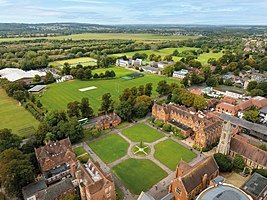
St Edward’s is located in the green north of Oxford and is an impressive Victorian red-brick school centred around a beautiful large quad, set within around 40 hectares of grounds. A location that is hard to beat – and for good reason.
Oxford is known worldwide as the university city, and this academic spirit is something pupils at St Edward’s feel every day. Life here doesn’t take place solely on campus: hop on a bike and you’re in the city centre within five minutes. Pupils attend university lectures, visit museums and theatres, or even book out an entire cinema for the Sixth Form to watch "Wicked" together.
City and Campus
Those who prefer to stay closer to home can walk to Summertown in just a few minutes – a charming local high street with everything one could need, from cafés and small boutiques to supermarkets. The local pizza place even earns five stars from our student tour guides.
Oxford also offers a direct bus connection to Heathrow, making travel remarkably straightforward – a real advantage for pupils living here for several years. Being able to fly home easily makes a genuine difference. And, of course, London is just as accessible, whether for a Harry Potter evening or simply to soak up some big-city energy.
Charming Chapel
At the same time, St Edward’s is far enough removed from the bustle to offer space for focus and retreat, allowing pupils to experience boarding life in its full richness. As our colleague Leslie put it so aptly, "everything here feels perfectly proportioned": the campus is compact without feeling cramped, and spacious without being overwhelming. Buildings sit close together, yet there is plenty of room to breathe and move freely. The chapel is charming, though on the smaller side – services are therefore usually held by individual houses rather than the whole school.
The Quad Project
What St Edward’s may lack in chapel size, it has more than made up for elsewhere in recent years. The Quad Project, opened in 2021, has introduced an impressive ensemble of contemporary buildings. At its heart sits the L-shaped Academic Centre, home to a café, library and modern classrooms. On the top floor, a Sixth Form study space opens out with views across the quad – a spot we found particularly striking. Pupils love having welcoming spaces beyond their boarding houses where they can study or simply relax together.
Nearby, the former 1970s assembly hall has been replaced by the elegant oval Olivier Hall, which seats up to 1,000 people for performances and concerts. When we visited, a professional stage set was being assembled – and the hall regularly attracts audiences from across Oxford.
Own music school
For those for whom music is an essential part of school life, the generously equipped Ogston Music School is a real highlight. It offers 20 practice rooms, seven ensemble rooms, a large rehearsal and concert hall, a dedicated Rock Room with recording studio, and its own music library. Hallelujah!
During our tour, Enno also shows us the dining hall – simple, welcoming and full of character. As two boys pass us, they call out enthusiastically that the food here is excellent. Such praise for school catering is not something one hears every day. And while enjoying your spaghetti, you’re constantly reminded that rowing is deeply embedded in St Edward’s DNA: old oars line the walls, alongside boards listing decades of regatta winners.
“Next year my name will be up there too – with the first crew,” Enno says, his goal clearly in sight.


What, in our view, makes St Edward’s special
Without a doubt, St Edward’s location is exceptional. Oxford is not simply “nearby” – it becomes a natural part of everyday life. Moving through the city, cycling everywhere, using university sports facilities and benefiting from links to the universities, including lectures by renowned professors, all create a sense of freedom, intellectual ambition and independence. For academically motivated pupils, it is a rare opportunity to breathe the air of a truly world-class university environment.
Rowing at St Edward’s is in a league of its own. The school offers professional coaching and its own boathouse on the river, and has built an outstanding sporting reputation. Few schools can claim to have fielded two boats at the prestigious semi-final of the Henley Royal Regatta – a clear testament to excellent coaching and exceptional conditions.
Boys are not afraid to dance
At the same time, the creative programme is equally impressive, with even the boys encouraged to explore dance and drama. Renowned actors such as Laurence Olivier and Emilia Clarke once rehearsed on the very same stages.
Just as striking is the balance between strong academic achievement and a noticeably low-pressure atmosphere. St Edward’s stands for focused learning, but without the intensity or strain sometimes associated with high-performing schools. Instead, it offers an environment in which curiosity and motivation are actively encouraged – and where making mistakes is seen as a natural and welcome part of learning.


The Academics
In its admissions process, St Edward’s is more selective than many other schools. However, this selectivity is not about creating uniformity; rather, it focuses on establishing whether St Edward’s is genuinely the right fit for each individual pupil. Naturally, this careful approach does have an impact on outcomes.
A clear trend in the IB
Academically, St Edward’s has shown a clear upward trajectory over recent years. 46% A grades at A-Level and 66% grades 9–7 at GCSE. In the IB Diploma, the average score is 35 points – an excellent result and five points above the global average. GCSE results are equally impressive: almost two thirds of all grades were awarded at 9–7, the highest marks available. These are, in fact, the strongest results in the school’s history.
Unsurprisingly, such results open doors to leading universities in the UK, including Bristol, Edinburgh, UCL and Imperial College London, as well as to top international destinations such as Berkeley, UCLA, Brown, Columbia and Harvard, and universities in Hong Kong, Germany, Italy, the Netherlands and China.
A wider range of IB subject choices is available
St Edward’s offers a broad and well-balanced curriculum in which the IB Diploma and A Levels sit side by side as equal pathways. Classical subjects such as Latin and Greek remain an integral part of the curriculum, design plays a significant role, and modern languages are firmly established, with around two thirds of Sixth Form pupils continuing them. At the same time, the school continues to evolve: recent additions include IB Dance and A Levels in Computer Science, Textiles, Politics and Psychology.
Sixth Form classes are deliberately kept small, usually well below the maximum size of 14 pupils. Regular involvement from Oxford postgraduate students adds further academic depth, always with the aim of encouraging curiosity and engagement beyond the syllabus.
There’s truly something for everyone
The IB Diploma is where the school’s particular strength becomes especially clear. While at many British boarding schools the IB remains something of a niche offering, at St Edward’s it is a genuine flagship programme. Headmaster Alastair, who has played a key role in shaping this development, explains it succinctly:
“We have an IB cohort of around 70 pupils, with an average result of 35 points. Within that group are also the 20 pupils who need to achieve 40 points to study medicine. So you can see that pupils reach their individual goals. But we don’t only focus on the academically strongest. We also find the right pathway for those who are less strong. There isn’t just one mould into which everyone is expected to fit.”
Key mentors
Anna Fielding, Director of IB, plays a pivotal role in the programme. Her commitment goes far beyond academics. Three times a week she meets pupils in small groups, understands not only their academic progress but also the social dynamics at play, and builds a level of trust that is truly remarkable. It is no coincidence that she is regularly invited to former pupils’ weddings and consulted on important life decisions.
IB, yet refreshingly stress-free?
And what about pressure – often a constant companion of the IB elsewhere? Anyone familiar with the demanding timetable and extensive additional requirements, most notably the Extended Essay, knows how challenging the programme can be. At Teddies, however, a well-balanced approach has been found. Because the minimum stay at the school is two years, the workload is spread more evenly over time. The school does not have to support pupils who are trying to experience and achieve everything in the shortest possible period. Elsewhere, this can lead to extremes: initial laissez-faire attitudes followed by overwhelm. At St Edward’s, effort is distributed more sustainably, which has a noticeably calming effect.
“As a pupil, you are focused and ambitious,” one student explains, “but not obsessed.”
The results speak for themselves.


The Extra-Curricular
In terms of sport, Teddies offers a broad and impressive range, supported by outstanding facilities. Given its location in Oxford and on the River Thames, it comes as no surprise that rowing has a long and deeply rooted tradition here. The strongest rowers train alongside university crews, and in 2023 the boys’ VIII won the prestigious Princess Elizabeth Challenge Cup at the Henley Royal Regatta – beating the German national champions (!) as well as Hampton, Eton, Radley and St Paul’s in the final.
Rowing in the DNA
Enno trains nine times a week and seems remarkably relaxed about it. “The school gives me exactly the right level of support, so I can train seven days a week, and on two days both mornings and evenings,” he explains. Despite this demanding schedule, he still has time for other clubs and for his IB studies.
Alongside rowing, St Edward’s offers strong football for both girls and boys, and particularly impressive rugby. The sports facilities are exceptional: 15 playing fields, indoor and outdoor tennis courts, a 25-metre swimming pool, four AstroTurf pitches, brand-new netball courts, squash courts, two cricket pavilions, and a superbly equipped fitness and wellbeing centre run by Nuffield Health, all on campus.
The outstanding North Wall Theatre
In the performing arts, Teddies demonstrates real cultural depth. The North Wall Theatre on campus is both the creative heart of the school and a nationally significant arts centre. It hosts professional productions, meaning that pupils sometimes have the opportunity to meet actors after performances or take part in workshops. The stage feels more like a city theatre, and the current set design struck us as sophisticated and meticulously thought through – thoroughly professional. St Edward’s even offers IB and A Level courses in Drama & Theatre Studies.
What stands out is how confidently boys, including those from the First XV rugby team, engage in creative subjects – particularly theatre and dance. From hip hop and ballet to dance fusion, Afrobeats and breakdance, pupils are encouraged to try it all.
Modern art studios and jewellery workshops
In the visual arts, the ceramics department particularly caught our attention, as did the passion with which a teacher explained that there is far more to ceramics than pots and wheels. In addition, the school boasts its own (!) jewellery workshop and modern art studios.
Music plays a big role
Musically, too, Teddies pulls no punches. Everyone sings – if only in the eagerly anticipated annual House Singing competitions. Those who want to take it further can join one of the two Chapel Choirs and, with a bit of luck, perform on exceptional stages such as the Royal Albert Hall in London. Alongside its dedicated music school, St Edward’s has its own Symphony Orchestra (entry is highly selective), as well as several wind and string ensembles. Pupils who prefer a less classical route can join one of the many jazz, rock or pop bands.
Societies are a gateway to new friends
And even after sport, theatre or music, the day at St Edward’s is far from over. Countless societies and clubs invite pupils to explore new interests and deepen existing ones. From Debating and Model United Nations to beekeeping and the Eco Society, from the Crochet Society (yes, crochet!) to Teddies on Camera or the Financial Markets Society, the range is extensive and truly offers something for everyone.
These societies are not only a gateway to new interests, but also play a vital role in helping pupils settle in. Our German student Katrina, who joined as the only new pupil in Year 12, told us that she made her first friends through clubs and societies.
“At first I found it hard to make friends with the girls in my boarding house,” she explains. “But then I signed up for lots of clubs and societies, and that’s where I made my first friends. After that, friendships developed in my classes too – and now I feel completely at home in my house as well.”


The Boarding
St Edward’s currently has 13 boarding houses: four for boys, five for girls and four co-educational houses specifically for the Sixth Form, including the newly opened Cooper Lodge. Each house is home to a mixed community of around 60 boarders and day pupils. The co-educational houses in particular are highly sought after, as only a small number of schools in the region offer this option. As we walked through the houses, it was clear how much investment has gone into them in recent years. The boys’ houses have been visibly modernised, even if they are still very much “boys’ houses”. The newer girls’ houses, by contrast, are architecturally so refined that they would not look out of place in an episode of Grand Designs.
The weekends are busy
With a full-boarding proportion of 80–90%, life on campus is lively – and not just during the week. Saturday school is part of the tradition, followed by sport in the afternoon. Afterwards, pupils can choose to stay on campus or head into Oxford. Older pupils in particular enjoy a high level of independence and experience the city as a natural extension of their boarding school life. Those who remain on campus benefit from a full weekend programme: social events, activities, trips, talks, dinners, barbecues, paintballing and trampolining – but also the freedom simply to relax and do nothing with friends.
IB Director Anna told us, via our guide Enno, that in the evenings he often goes over to see his younger sister, who has only recently joined St Edward’s, to speak a little German with her and give her a sense of home. It is a warmth and attentiveness that is actively supported by the houseparents.
Strict phone policy
One final aspect that particularly impressed us is the school’s fairly strict phone policy. During the week, mobile phones are generally not permitted; they may only be used at weekends or in the evenings, and even pupils in the Upper Sixth are required to hand in their devices regularly. Johann, who walked with us for part of the tour, summed it up pragmatically and rather aptly: “It’s absolutely fine, because we’re all in the same boat.” At a time when digital overstimulation is becoming an increasing challenge, Teddies creates a space in which young people can live, work and connect with one another in a more focused way – and, judging by their response, they seem to appreciate it.


Our Verdict – Who is St Edward’s right for?
St Edward’s is particularly well suited to young people who are looking for more than a traditional boarding school experience. Pupils who are considering a future academic pathway towards Oxford or Cambridge benefit enormously from the school’s location and atmosphere. Studying here offers an early and authentic insight into what academic independence, intellectual curiosity and student-style freedom can feel like.
At the same time, St Edward’s is an ambitious school that does not expect everyone to follow the same route. Its philosophy is clear: each pupil should be free to find their own path – whether academically, in sport or in the arts. No one is forced into a mould; instead, the focus is on identifying individual strengths and nurturing them thoughtfully.
It is a busy, vibrant school. Those coming to Teddies should enjoy being actively involved in school life, whether through sport, music, drama or societies. St Edward’s is the right place for young people who bring energy, enjoy being part of a dynamic community, and approach life with curiosity and openness.