



British Boarding Schools in Profil: Canford School: A Confident Step Towards the Future

As Claire Vandvik from the Admissions Team opens the heavy wrought-iron wooden door and welcomes us in with a bright “Welcome to Canford School!”, the tone for the visit is set: historic surroundings meet grounded warmth and a genuine commitment to creating a well-rounded boarding experience.
One could almost stop writing here. But that would hardly do justice to this visit – and you, dear reader, would miss a deeper insight and a few unexpected stories about this remarkable school. So, let us rewind to the beginning.
On one of the first days of spring this year (following a typically English winter defined by damp, cold and an abundance of rain), we set off for one of the most beautiful and unspoilt regions of southern England. The satnav read: Canford School, Canford Magna, Dorset.
Boarding Schools in the Age of AI
We spoke with Headmaster Chris Wheeler about education in the age of artificial intelligence, what truly motivates pupils, and a phone mantra every student knows by heart. Afterwards, we explored the campus with two charming Sixth Form students, Sophia (pronounced in Old English style: /soˈpʰi.a/) and Ollie (who simply calls her “So” – efficient!).
They guided us through classrooms, the library, the sports centre, an impressive dining hall and a girls’ boarding house. Along the way, they effortlessly entertained us with stories ranging from a genuine Assyrian wall relief to self-built Mars rovers and poetry read around a campfire.
And, perhaps most strikingly, we were all quietly touched when Ollie paused to point out the beauty of the park. Hand on heart: how many sixteen-year-old boys do you know who spontaneously talk about nature? And he is not the only one here.
Not a hidden gem for much longer
At the end of our visit, over lunch (unfortunately not with the pupils this time, which we usually enjoy), we spoke with the Admissions Team about international students. Interestingly, they were keen to hear what more the school could do to support German boarders.
On the drive home, one thing was clear: Canford will be one of the schools we recommend more often in the coming years. Why? Because it is a school full of stories, warm people and high standards – and one that thinks carefully about the future of its pupils.

The Setting
If you travel to Canford School, you really mean to go there. The school, with around 640 pupils, lies roughly two hours from London, set within gently rolling countryside. The nearest international airports – Bristol and Heathrow – are not exactly around the corner either. That said, the school organises transport, and trips to larger towns such as Southampton or Shaftesbury (both under an hour away) are popular with pupils.
Cream Tea and Supermarkets
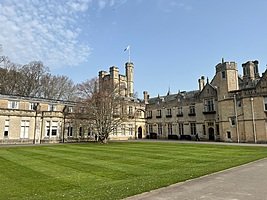
For the past 100 years, the school has been located on a spacious 250-acre campus on the edge of the small village of Canford Magna. Following the River Stour, which runs through the grounds, you can enjoy a scenic walk to Wimborne – “where you can have a proper cream tea,” as Claire tells us. Naturally, there are also supermarkets nearby, much appreciated by boarders.
The setting is ideal for outdoor activities and not far from the spectacular Jurassic Coast, a UNESCO World Heritage Site. This alone is one of the reasons Canford was named Best Independent School in the South of England at the Independent School Parent Awards 2025.
Transformed by Sir Charles Barry
Alongside the classic sports fields for rugby, cricket, tennis, football and hockey, the campus also boasts a nine-hole golf course – and, of course, that beautiful park.
Originally, the school was a country estate with medieval roots, later transformed in the 19th century by Sir Charles Barry, architect of the Houses of Parliament, into an impressive Victorian mansion. It was during this period that the Great Hall – now the dining hall – was created.
Dining in First-Class Style
You could see how much the Admissions Team enjoyed showing us this space. This was no ordinary dining hall, but the very embodiment of grand, aristocratic dining. The high room is framed by dark wooden panelling adorned with intricate carvings. A vast stone fireplace and a painted wooden ceiling dome could easily have served as a film set for a swashbuckling historical drama. Stained-glass windows and an enormous chandelier lend the space an air of grandeur.
And beneath it all? The most practical tables and chairs imaginable. Welcome to boarding school.
Naturally, one question remained: how is the food? “We’ve got a new chef, and the food is really good,” Sophia assured us.
This is something we are seeing more and more: schools placing greater emphasis on balanced nutrition and upgrading their catering. Good news for the pupils. And yes, we know that the kitchen at Canford still prepares meals for 640 students. So while the food may be good – is it like home? Probably not.
Two New Boarding Houses Under Construction
Although the campus is extensive, the academic buildings, facilities and girls’ boarding houses are all within easy reach. The boys’ houses are a short walk away and were not part of our tour. “But it’s not far,” says Ollie, “and it gives you time to chat with friends.”
Next to the historic main building, construction is currently underway. By the end of 2026, two new Upper Sixth boarding houses will open. Already in use is the newly completed Sixth Form College Hub: a thoughtfully designed space combining comfortable seating, modern facilities and study areas within the historic architecture. At weekends, the small bar opens, offering a place to unwind after a busy week.
The project comes at a cost of £20 million, but according to Headmaster Wheeler, the school is financially well positioned – not a trivial point at a time when rising costs are forcing some UK schools to close.
An Assyrian Treasure
That said, not every school can claim to have funded its development through the sale of an Assyrian artefact.
In the Nineveh Café – a popular spot for chocolate bars, muffins and hot chocolate – our guides showed us a life-sized replica of an Assyrian wall relief. “The original used to hang here,” Ollie explained. “For years, everyone thought it was just a plaster copy.” No wonder a dartboard had been mounted in front of it for use during breaks.
As it turned out, the piece was genuine, originating from the palace of Ashurnasirpal II in present-day Iraq. In the mid-1990s, it was sold at Christie’s for over £7 million – a record sum for an antiquity and a welcome financial boost for the school. The proceeds funded sports facilities, the Layard Theatre, a scholarship fund – and, apparently, a chocolate bar for every pupil.
Still smiling at the story, we made our way to the Layard Theatre. With 300 seats, it is not the largest venue – only half the school fits in – but it is perfectly suited to the ambitious productions staged here, many of which have won awards.
Phone Mantra
On our way to the sports centre, we walked past trees and fields of daffodils. A lovely sight – and one the pupils clearly notice. Headmaster Wheeler tells us about a group of “edgy teenagers” who, to his surprise, once came to his office to discuss the Redwood and Katasuka trees (the latter one of only two in England). Others simply enjoy walking through the grounds with friends.
Perhaps this appreciation is linked to the school’s phone policy, summarised in Wheeler’s oft-repeated mantra:
“Eyes up, forward and out.”
When pupils are not constantly looking at their phones, they begin to engage more with the world around them. And if someone does take out their phone to capture a particularly beautiful sunrise, Wheeler admits he may occasionally turn a blind eye.
Good connection to community
The sports centre is in excellent condition and was, during our visit, being used for early morning exercise by local residents. “Local clubs train here too,” Ollie tells us – a sign of the school’s strong ties to the community.
In the bright library, we were greeted by a friendly librarian who would very much welcome more German pupils – if only to improve her own German. At the moment, the focus is on Japan. Up to Year 11, pupils have two compulsory 30-minute reading sessions each week. The rotating themes in the library – changing every two weeks – help keep things fresh and engaging. Ollie is currently reading a book about his mathematical hero, Jim Simons, founder of Renaissance Technologies. Why not.
Overall, Canford offers a highly appealing learning environment.

What We Believe Makes Canford School Stand Out
For those ready to embrace a true boarding school experience, Canford offers everything one might hope for. Set within a beautiful estate complete with its own golf course, the school combines unmistakable British character with a strong academic ethos. That said, Canford is not a school for city children – life here largely revolves around the campus itself.
Alongside this comes a strong sports programme, particularly in hockey, cricket, netball, tennis and football, with teams regularly reaching semi-finals and finals in school competitions.
The creative arts are not to be overlooked either. With the Layard Theatre, Canford has its own stage, hosting regularly ambitious productions – some at national level. Drama, in particular, stands out compared to many other schools. This is complemented by a wide range of concerts and exhibitions.
The pupils are friendly, grounded and open. And despite a demanding timetable and a full programme of afternoon activities, no one appears overwhelmed – quite the opposite. Not least, under Headmaster Wheeler, there is a noticeable sense of fresh energy running through these historic buildings.

Academic Life
Academically, Canford is something of a flagship school in the South West of England. Last year, 71% of GCSE results were graded 9–7, while A Level results saw 55% of grades at A*/A and 84% at A*–B.
Ten GCSE subjects form the standard programme. A modern foreign language and two sciences are compulsory, while pupils can also choose subjects such as Business Studies or Computing. Ancient Greek is offered as well, though outside the regular timetable.
To prepare for his GCSEs, Ollie and his friends booked a seminar room next to the library and revised together. He describes it as a genuinely enjoyable experience – learning collaboratively in a supportive environment.
Excellent Support from Teachers
“The teachers encourage our academic ambition, but they don’t force it,” he explains. Having achieved strong GCSE results, he is now studying Maths, Further Maths, Physics and Economics at A Level.
In the Sixth Form, pupils can choose from 19 A Level subjects. In addition, there are university preparation options in areas such as Art and modern languages. While the IB (International Baccalaureate) is not offered, certain elements have been incorporated into the Sixth Form curriculum.
With lessons on Saturdays, small class sizes of around 14 pupils at GCSE level and approximately nine in Sixth Form, the learning environment is both focused and supportive. Walking through the maths building, we pass a small group of five pupils gathered around a table, while a teacher explains a problem at the whiteboard. These informal maths tutorials are a regular feature, Sophia tells us – an opportunity to deepen understanding during free periods.
Yellow Hour
Sophia herself has chosen Politics, English and History for her A Levels. To bring learning to life, the school offers creative formats such as the “Yellow Hour” – a rather unusual poetry lesson: “We all met in the woods and read poems around a campfire.” It is moments like these that turn abstract learning into something memorable.
The Design and Technology department is well equipped. As we enter, several 3D printers are quietly at work. Pupils are free to use them, and it is fascinating to watch ideas take shape layer by layer. On the shelves sit a variety of small, self-built vehicles.
“Every year there’s a robotics competition where you design a Mars rover that has to pick something up,” Ollie explains. “It’s then tested on a ‘Mars terrain’. It’s quite exciting to see which one actually works.”
Preparing Children for the Age of AI
In the age of artificial intelligence, Headmaster Wheeler is actively rethinking what education should prioritise.
“We ask ourselves: what will matter after AI? Emotional intelligence, adaptability, thoughtful reflection, engagement and the deliberate fostering of humanity are at the top of our agenda.”
These qualities are difficult to measure, he admits – but visible in everyday interactions. He recounts a discussion between two pupils during a physics experiment:
“It was the way they spoke to each other – not arrogant or dismissive when something wasn’t precise, but working together respectfully to agree that the potato had to be exactly three centimetres long.”
In Wheeler’s view, it is precisely this humanity that will distinguish us from machines in the future.
Future Pathways Centre for Higher Education
The transition beyond school is handled with equal care. Around 80% of pupils go on to Russell Group universities, including Durham, Bristol, Exeter, Manchester and Bath. In 2025, six pupils also secured places at Oxford and Cambridge.
However, preparation begins long before applications are submitted. Within the Sixth Form College Hub sits the Futures Pathways Centre for Higher Education, where pupils are supported early on in planning their next steps – whether that is university in the UK or abroad, a degree apprenticeship, or a foundation course in art and design.
“What you give in, you get out,” says Sophia, who initially felt unsure about her future. With guidance from her teachers, she has now mapped out a clear path towards Oxbridge and is working towards it.
In a world that is changing rapidly, Canford sees this phase as a shared responsibility – supporting each pupil individually as they shape their future.

Extracurricular
Sport plays a significant role at Canford, although it is not one of the country’s absolute top sports schools. Winning matters here, but it is not pursued at all costs. Around 550 pupils compete across 12 sports, taking part in more than 300 fixtures each year.
Given the size of the campus, it is no surprise that there is an impressive number of rugby, hockey and cricket pitches, two astroturf pitches, tennis courts, numerous athletics facilities – and even a nine-hole golf course. Seeing it all would have taken us half a day. Instead, we visited the sports centre – the largest in the region – which includes a dance studio used for yoga and Pilates, two spacious and light-filled gyms, and a bright 25-metre swimming pool with spectator seating. Ollie used to come here regularly in the evenings for a swim to unwind. A lifeguard is always on duty.
Ambition with Balance
Canford is particularly strong in rowing, with regular success at national level. Its location on the River Stour is ideal: “I train twelve times a week – either in the gym or on the river. During the week I’m up at 6am for morning training, and then back again in the afternoon and on Sundays.” Listening to this alone feels exhausting, yet Ollie does not appear overwhelmed – quite the opposite. There is even time for a girlfriend.
At the same time, the school knows how to develop pupils at different levels: “We had a student who hated rugby. But we introduced him step by step. He started with touch rugby, enjoyed it, improved, and now plays in the first team.” The kind of story schools like to tell – but here, it feels credible.
The Real Tennis
The overall sports offering is broad, but one particularly unusual feature is the real tennis court. This is the original form of tennis, played as it was in medieval times – using walls, angles and windows as part of the game. Canford is one of only a handful of schools in the UK to offer it.
The creative arts are equally compelling. Alongside exhibitions, ceramics, metalwork and fashion shows, 100% of pupils go on to portfolio-based foundation courses after school. The Layard Theatre is a second, highly visible pillar of school life. With six productions a year and a dedicated team behind the scenes, the programme is busy – and the standard is high. According to Wheeler, he has rarely seen anything quite like it.
It is also the pupils themselves who drive one another forward. “In the last production, The Addams Family, one of the girls from our house performed,” Sophia tells us. Naturally, the whole house turned out to support her. Experiences like this create a strong sense of community – the excitement of the stage carries straight back into the boarding house.
Friday Foyers
The theatre department also runs the “Friday Foyers” – informal performance opportunities open to anyone who wants to take part. In a supportive and relaxed atmosphere, pupils can try things out and build confidence.
“It’s a space where pupils learn to present themselves and develop soft skills in an increasingly digital world,” says Wheeler. He would like to see even more pupils engage with drama as part of both their academic and extracurricular life.
Music at Canford
A brief look into the music department and concert hall – still being reset after a recent “Jazz Night with Dinner” – gives another glimpse into school life. Sophia points us towards the school’s own YouTube channel, Music at Canford, which offers perhaps the most authentic insight into its musical culture. Bands, choirs and solo performances all demonstrate a high standard.
For international families, the livestreams are particularly meaningful. “My mum sends me screenshots saying, ‘Look, I can see you,’” Sophia laughs. “It’s a big thing” – for everyone.
(You can take a look yourself here: Music at Canford)
Finally, it is worth mentioning the popular Combined Cadet Force (CCF) programme. Here, pupils develop teamwork, leadership and resilience through structured, military-style activities. The school has its own rifle range and assault course, and pupils can work towards qualifications in activities such as powerboating, diving and clay pigeon shooting.

Boarding
Around two thirds of pupils at Canford are boarders, with roughly 60% boys and 40% girls. Of these, around 15% come from overseas, ensuring a distinctly British environment.
Of the seven boarding houses (four for boys and three for girls), we visit the girls’ house Beauford, where Sophia lives alongside around 60 other pupils from Year 9 onwards. Although the official house colour is pink (don’t worry – it’s subtle), the house itself offers a lively yet relaxed atmosphere. Alongside a table tennis table and a pool table, there are plenty of comfortable sofas with a clear sense of territory: “The Shells sit over there – the 13- and 14-year-olds. We sit here,” says Sophia.
Enough Space for Socialising
The open kitchen invites shared cooking, while those seeking quiet can retreat to the piano room or their own bedroom. The younger girls share four-bed rooms, while Sixth Form pupils have single rooms with a sink; showers are located along the corridor.
Life in the house is well organised. In addition to the houseparents and dedicated teams who oversee daily life, older pupils play an important role in shaping a positive house community and atmosphere. Through a two-week peer mentoring programme, they are trained to support younger pupils as they settle in – a system that clearly works and is warmly received by the younger girls.
Buzzing weekends
Weekends are lively: around 80% of pupils remain on campus, creating a strong sense of community. Many day pupils even return to join in the varied programme of trips, sport and shared activities.
A final note on the phone policy: Sixth Form pupils hand in their phones at 10:15pm, while Years 9 and 10 have access only between 4:30pm and 7:00pm.
Who Is This School For?
Canford is a thoroughly convincing all-rounder: a “proper” boarding school, grounded and down to earth, yet with a strong academic core. At the same time, it feels relatively relaxed – not least because the assessment system is not overly selective.
This is a place where pupils can explore their interests – whether in sport, the arts or academics – and find the right support in each area.
For families looking for an idyllic countryside school that is large enough to offer a wide range of opportunities, yet small enough for people to know one another, Canford should certainly be on the shortlist – not least because of its beautiful setting in the south of England.