


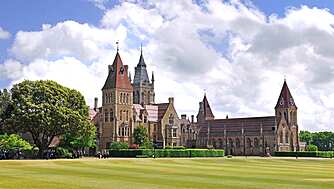

British Boarding Schools in Profile: Charterhouse – where tradition meets the future

One of our most recent school visits took us to Charterhouse, a school that is very much an academic powerhouse and is frequently mentioned in the same breath as Eton, Wellington and Sevenoaks. As one of the leading IB schools within easy reach of London, revisiting Charterhouse was a clear no-brainer for us. After all, we have worked closely and happily with the school for over 20 years.
There have also been significant changes in recent years. Charterhouse is now fully co-educational, welcoming girls from the middle school onwards. Understanding what this shift means for the school’s culture and dynamics was another key reason for our visit.
Our guides on this visit were Anna from Düsseldorf and Elia from London, two Sixth Form pupils who left a strong impression. Elia is already the third generation in his family to attend Charterhouse, following in the footsteps of both his father and grandfather. Anna, meanwhile, impressed us by leading the tour with remarkable confidence after having been at the school for just under two months.
We also met with IB Coordinators Simon and Catherine to discuss the development of the international strand, and finally Sarah from the Admissions team accompanied us to the far end of the campus to show us the boarding houses and sports centre.
Because even though Charterhouse is widely regarded as an academic powerhouse, it also offers an exceptionally broad co-curricular programme, ranging from music, theatre and sport to a wide variety of clubs and societies. And have we mentioned football yet? It plays a major role here — not only because real football history was written on this ground, but also because the sheer number of pitches we passed on our tour makes it very clear how many pupils choose to spend their free time on the pitch.
For you, dear readers, we easily clocked up 10,000 steps that day — not least thanks to those football fields. You, on the other hand, can now put your feet up and simply join us on our tour of Charterhouse.

The Setting
Charterhouse is just a stone’s throw from London. From Godalming, the picturesque historic market town on the edge of which the school is located, direct trains reach central London in around an hour. This proximity to the cultural life of the capital is an advantage not only for pupils, but also makes the school particularly attractive to outstanding teaching staff.
With some 45 nationalities represented among its approximately 1,000 pupils, it comes as no surprise that around a quarter arrive via Gatwick or Heathrow. From either airport, Charterhouse can be reached in roughly 45 minutes — a definite plus.
Despite its excellent transport links, Charterhouse is very much a world of its own — and one that does not necessarily reveal itself at first glance. Lined with football pitches, lawns and tree-lined avenues, visitors are initially welcomed by a discreet, low-rise building. It is only when Anna and Elia lead us around the corner that the school’s more than 400 years of history and its 100-hectare campus truly unfold. And when a quiet “Oh!” ripples through our group, it becomes clear that Charterhouse has a definite Hogwarts factor.
Grand historic buildings with cloisters and courtyards, an imposing bell tower and the highly impressive 100-year-old Memorial Chapel sit closely together within expansive parkland and sports grounds. Three times a week, the entire Sixth Form gathers in the chapel. “We listen to talks on all sorts of topics here — from mental health to Coffee Day,” Anna explains, before adding with a smile, noticing our raised eyebrows, “After all, not everything at school has to be serious all the time.”


Founded in London in 1611 and relocated to Godalming in 1872 due to lack of space, one might assume that time has stood still here. Far from it. Charterhouse is anything but stiff, dusty or old-fashioned. Tradition here does not mean stagnation. A new art wing has only recently opened, and the two newest boarding houses are just a few years old, combining a clean, contemporary design with a warm and welcoming feel.
With Anna and Elia, we walk over to The Hub, a modern building that features generous sofa areas and interactive whiteboards — and also houses what is quite possibly the most modern classroom we have encountered on our school visits so far. Lessons are in full swing: pupils sit in comfortable swivel chairs, iPads resting on integrated desks, while economics is being taught at the whiteboard.
It is precisely these details and forward-looking investments that create an atmosphere in which learning feels both enjoyable and genuinely valued. We see this reflected in the library, which is comfortably furnished and well used. In all honesty, however, academic ambition alone is not the reason for its popularity. “The furthest boarding houses are a 15-minute walk from here. Some pupils prefer to spend their free periods here,” Anna notes with a smile.
Between the main campus and a cluster of eleven boarding houses (fifteen in total), much of the school’s impressive sports infrastructure is located, with pitches for football, cricket and more. Beyond the boarding houses, the campus continues with tennis courts, outdoor facilities and even a golf course. As we step into the Queen’s Sports Centre — home to a large sports hall, a climbing area and a 25-metre swimming pool — the atmosphere is electric: eight swimmers are in the water, loudly cheered on from the stands.
Despite its sheer scale, the campus feels safe, and the pupils we pass in large groups seem entirely unfazed by the distances involved. The only real mistake one can make at Charterhouse is leaving one’s bag behind in the boarding house.


What makes Charterhouse truly distinctive
Over the past eight years, Charterhouse has evolved under the leadership of Headmaster Dr Alex Peterken. Academic excellence remains at the core of the school, with the IB once again gaining prominence and now supported by a strong cohort. Football, cricket and hockey continue to be the main sports, but the school is now around 40 per cent female, with that proportion steadily increasing. This shift has undoubtedly contributed to the growing strength of the creative and music departments alongside the already extensive sports programme.
Charterhouse remains a heavyweight among the UK’s elite boarding schools and, thanks to the size of its pupil body, is able to offer an academic and co-curricular breadth that smaller schools simply cannot match. Another clear strength is the way Charterhouse successfully balances its deep-rooted traditions with a forward-looking mindset.
At the same time, the school is fully aware of its standing and does not shy away from its reputation. It is a school of real stature — and one that is very much in the midst of thoughtful evolution.


Academic Excellence
Charterhouse is without question one of the most academically demanding schools in the country, and this is reflected not only in its curriculum but also in its results. In 2025, more than 75 per cent of pupils achieved GCSE grades 7–9. At A-Level, 54 per cent of results were A/A*, with 83 per cent achieving A–B*. In the IB Diploma, pupils achieved an average score of 37 points — 6.5 points above the global average.
These are impressive figures, but they tell only part of the story. Behind the results lies a culture that combines high academic expectations with a strong sense of community. As we pass a classroom where just three pupils are studying Mandarin, Anna mentions that there are also only three pupils in her German class. This creates an intense but not exhausting learning environment, as teachers have the time and resources to work closely with pupils and support them individually. School here, she says, is simply “fun” — a sentiment that feels refreshingly different from many experiences elsewhere.
The range of options available after GCSEs is broad, and Charterhouse shows no hesitation when it comes to offering less traditional subjects. Psychology and Sports Science have been added to the curriculum in recent years. While Mathematics and Economics dominate statistically, English, the sciences and History are also very popular. Smaller subjects such as Art, Latin and Classical Civilisation consistently achieve a high proportion of top grades. Even Philosophy is experiencing a revival, fuelled by growing interest in the ethical questions surrounding technology.
Around one fifth of pupils opt for the IB, a proportion that continues to rise. IB Coordinators Catherine and Simon are pleased with current cohort sizes, with 38 and 39 pupils in the two examination years providing healthy, sustainable groups. Languages such as French, Spanish and German tend to be smaller at A-Level but perform particularly well within the IB, alongside additional offerings in Italian and Mandarin.

.jpg.webp)
If pupils find that they are struggling to keep up in lessons, they can make use of one of the many academic “clinics”. These sessions take place before the school day begins and give pupils the opportunity to discuss questions or difficulties directly with their teachers. This might involve a small group of four or five IB and A-Level pupils working through problem areas together with their maths teacher. If further support is needed, pupils can return by arrangement in the afternoon to clarify any remaining questions. Academic support is seen as an integral part of school life, and pupils are actively encouraged to seek help when they need it.
Amid all the structure and serious academic work, there is also something less tangible but just as important: enthusiasm. “Even the maths teacher is amazing!” Anna tells us.
Academic ambition at Charterhouse extends well beyond the classroom. During our visit to the library, we notice posters advertising “The 99”, the school’s annual reading challenge. Pupils who manage to read 99 books from a prescribed list within a year are awarded a Reading Needle, worn with pride on the lapel of the school uniform.
At the same time, the school is keenly aware that even a traditional education at a leading boarding school like Charterhouse is no longer a guarantee of a secure, well-paid career. Practical skills such as entrepreneurship are seen as equally essential. When pupils choose their subjects for the Sixth Form, they are therefore encouraged to reflect on which personal competencies they would like to develop further — and this is where the school’s own FutureU programme comes into play.
FutureU is designed to develop key life and future skills, ranging from time management, self-reflection and stress management to networking, financial literacy and personal branding. This approach runs through daily school life, from lessons and co-curricular activities to individual pastoral support, helping pupils to take responsibility, build on their strengths and pursue their own path with confidence and openness.
After graduation, most Charterhouse pupils progress to leading universities in the UK and abroad, with the majority choosing to remain in the United Kingdom. The University of Exeter is particularly popular, followed by UCL, Durham, Newcastle, King’s College London and Edinburgh. In 2025, six pupils received offers from Oxford and Cambridge, while three went on to study Medicine. Around 30 leavers chose to attend top universities overseas, including institutions in Canada, the United States and across Europe.
Beyond this, the school’s network of more than 4,000 alumni provides a strong source of support and represents a genuine advantage when pupils take their next steps into higher education and professional life.
.jpg.webp)
.jpg.webp)
Co-Curricular Life
Let us turn to the co-curricular programme. As already mentioned, Charterhouse makes every effort to live up to its reputation as a powerhouse beyond the classroom — and in our view, it succeeds on every level.
Starting with music, dance and theatre, the names of former pupils Peter Gabriel and Ralph Vaughan Williams say almost everything about the musical range Charterhouse makes possible. While Ralph Vaughan Williams composed operas, ballets, chamber music, secular and sacred vocal works as well as orchestral pieces from the early 20th century onwards, the pop band Genesis, led by Peter Gabriel, was founded right here at the school. That same breadth remains very much alive today. With around 1,100 music lessons offered each year, roughly half of all pupils are actively involved in music. The Chapel Choir is a longstanding institution, and many pupils find their musical voice in orchestras and jazz bands, a cappella groups, choirs and chamber ensembles. Many are also involved in the much-loved House Singing competitions. To support this, most boarding houses are equipped with pianos and dedicated music practice rooms.
Anyone living at Charterhouse will also be familiar with the BTT productions — the school’s own theatre and musical performances staged in the Ben Travers Theatre. With Performance Director Dean Chisnall, who takes on the lead role in The Phantom of the Opera in London’s West End in 2025, the performing arts enjoy exceptional popularity. Unsurprisingly, announcements of upcoming BTT productions read much like a West End programme themselves: from Frozen and Queen’s We Will Rock You to the play The Curious Incident of the Dog in the Night-Time. The production of The Addams Family earned the entire team a nomination for Best Musical 2025 at the National School Theatre Awards. “We often rehearse with two casts because so many pupils want to take part,” Sarah from the Admissions team tells us as we tour the theatre.
Adjacent to the auditorium is an equally impressive dance studio, boasting spectacular views of the surrounding countryside through its fully glazed façade. Here too, the school’s proximity to London seems to have attracted outstanding talent: the new Head of Dance also comes from the West End and teaches across all levels, from beginners to dance scholars. The dance scholarship itself has only been introduced this year — one to watch going forward.
.jpg.webp)
There is also plenty happening in the Design and Technology Department, where the ever-enthusiastic Mr Mellor speaks with real passion about his area and shows us the current upcycling project: soap dishes made from shredded milk bottles. Once completed, the pieces are not only displayed but also sold at events through the school’s enterprise group. “We’re trying to teach pupils the entire life cycle of a product,” he explains.
And then there is sport, which plays a central role at Charterhouse. The main sports — football, hockey, tennis and cricket for all pupils, as well as netball for girls — rotate depending on the term. Beyond that, virtually every sporting ambition is catered for year-round: across 20 grass pitches (three of them artificial), the athletics stadium, the sports centre with swimming pool and fitness suite, 27 tennis courts and even a nine-hole golf course.
Football, however, is the undisputed star among the sports on offer — not least because Charterhouse is considered one of the birthplaces of the modern game. Without Charterhouse, football might well be played very differently today. When the Football Association was founded in London in 1863, Charterhouse captain B. F. Hartshorne was present at the table. Several rules that are now taken for granted — such as the throw-in and the offside rule — can be traced directly back to the way the Carthusians played the game. It is therefore hardly surprising that the school nurtures its long sporting tradition with a certain pride and fields very strong teams, including a growing number of girls’ teams that have made a name for themselves.
Whether at a competitive level or simply as a balance to academic life, there is something here for everyone. Following the principle “try everything and narrow it down to what is achievable”, pupils are encouraged at the start of their time at the school to sample a range of sports before deciding where to focus.
Beyond sport, there are more than 65 clubs on offer, ranging from Entrepreneurship to Animal Studies. Elia opted for the latter and has already dissected a turtle. Judging by his expression, it may not have been entirely his thing — but that is precisely the point: pupils are encouraged to try things, including the unusual. And if a particular passion really takes hold, Sixth Formers can even found their own clubs and inspire others to join.
A varied programme of events further enriches life beyond the classroom. Whether it is the Charterhouse Talks & Lectures, featuring former pupils, diplomats and academics, or the five-day Artifex Festival with more than 100 events centred on art, music and creativity — “they inspire you,” Elia says with conviction.

Charterhouse's Golf Course (picture courtesy of Charterhouse School)
Boarding Life
Charterhouse is a full boarding school. Of its approximately 1,000 pupils, around 900 are boarders living across 15 boarding houses. Pupils aged 13 to 18 live together under one roof, with day pupils fully integrated into boarding life. The houses themselves reflect the school’s development over time, ranging from Victorian buildings and 1980s constructions to the newest houses, opened only a few years ago and designed in line with contemporary architectural styles.
A small tip for families considering the school: during a visit, it is well worth asking which boarding house a pupil would be placed in — to avoid any surprises once term begins.
Anna shows us her boarding house, Sutton, where she lives with around 65 other girls in the historic part of the school. At 150 years old, Sutton is one of the oldest houses on the main campus. Most of the other houses are located on the far side of the grounds, which means a considerably longer walk to lessons. The advantage there, however, is a clearer sense of separation once the school day ends and pupils head “home” for the afternoon and evening.
Anna enjoys Sutton and its proximity to the classrooms. Four members of staff live in the house alongside the pupils and are on hand overnight at all times. Younger pupils typically start by sharing rooms in groups of four, moving into twin rooms from Year 10 onwards. From there, they gradually progress to single rooms by the time they reach the Upper Sixth. Sutton, once a rather dark boys’ house, has been transformed through renovation into a warm and welcoming space, with plenty of wood, a piano and even a PlayStation.
“It was important for us to create an inclusive co-educational system in which girls have the same rights and access to boarding houses as boys. That meant some boys had to move out of the older houses to make space. We didn’t want girls to be seen as an add-on or placed at the far end of the campus,” Sarah explains. Today, the distribution of houses across the site feels well balanced.
Next to Sutton sits the boys’ house Gownboys. Of all the houses we visit, it feels the most traditional: generous communal spaces, large and elegant sofas, a PlayStation and well-equipped kitchen areas. Wooden panelling lines the walls, engraved with years and the names of pupils who have won competitions for their house.
A very different picture is offered by the two newest houses, Saunderites and Northbrook, located at the far end of the campus. One for boys, one for girls, the buildings mirror each other architecturally and were opened only a few years ago.
As the boys play table tennis in the common room, we have a brief conversation with house assistant Anne about the initial challenges for new pupils. “You wouldn’t believe it, but at the beginning everything revolves around knowing where to go,” she tells us. “Finding your way around such a large campus and getting to places on time is a real challenge for newcomers. And if a boy does come back with his shoulders slumped, I always say, ‘Tomorrow is another day.’ By dinner time, everyone is usually feeling better, and after the first few demanding weeks, they’ve all settled in and feel at home.”

Thanks to its proximity to London, Charterhouse has a large number of weekly boarders who leave school on Saturdays and return on Sunday afternoon. “The houses are all different, but it’s not uncommon for up to a third of pupils to leave campus on a Saturday afternoon,” Sarah explains. “It becomes quieter, but we always have a programme in place for our international pupils who stay.” In the evenings, pupils gather around a campfire, toast marshmallows and invite friends from other houses to join them.
On Sunday mornings, there is a leisurely, much-loved brunch served in a relaxed, almost hotel-style setting. Younger pupils tend to head into Godalming, while older students gravitate towards Guildford. With parental permission, small groups may also visit London. By no later than 24 hours later, however, all boarders are back on campus.
Mobile phone rules are no stricter here than elsewhere. Phones and laptops are handed in at 10 pm and returned at 7 am the following morning. In the final year, the Upper Sixth, all restrictions are lifted. “By then, the urge to constantly have your phone isn’t quite as strong anymore,” Sarah says with a smile.
A final word on food, which we did not sample ourselves on this visit: according to Anna, there is always a wide range of options available, from protein-based to vegetarian meals. The food in the dining halls is good and healthy, and for anyone still hungry, there is always the option to prepare small snacks in the boarding houses. No one goes hungry here.
Who we think Charterhouse suits best
Charterhouse is a school in which academically minded pupils with an appetite for a full and immersive boarding experience are likely to thrive. Pupils who already have a sense of what they may want to pursue in the future will find their ambitions actively supported, while those who are still exploring their path will gain inspiration, alongside a strong academic foundation and a valuable set of soft skills.
Charterhouse will suit pupils who are not intimidated by scale, space, traditional values and a large school community, but who are excited by the idea of becoming part of a proud and historic British institution.