


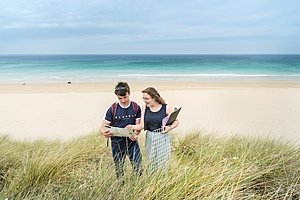


When you think of a boarding school by the sea, you might picture fresh sea air, long walks on the beach and perhaps a spot of sailing or surfing after lessons. As we talked about our favourite school locations, we started to wonder which British boarding schools really make the most of having the coast on their doorstep.
We’ve chosen five schools that make the most of the sea in very different ways. At some, pupils head to the coast for a lesson. At others, they take to the water for sport. And at one, pupils even help out on real-life rescue missions. Here are our five picks and what makes each one special.
Eastbourne College
Eastbourne College is just a few hundred metres from the beach in one of England’s traditional south-coast seaside towns. From some classrooms, you can look straight out over the English Channel, while just beyond the town are the green hills of the South Downs National Park. Sergiu, a former boarder we spoke to, told us that being close to the sea was one of the reasons he chose Eastbourne. At the College, that proximity shapes what pupils do before lessons, after school and in the time in between.
A run, a swim or a moment to yourself
Eastbourne calls itself a ‘Blue Health School’ and makes a point of using the coast to support pupils’ health and wellbeing. An early-morning run on the beach, a swim in the sea or a walk along the promenade can all be part of the school day. Pupils can learn to sail or windsurf in the summer term, and sailing continues in the autumn, with some sessions run by the watersports team at Buzz Active on the seafront. And sometimes, after a long day of lessons, all you want is to sit on the beach, look out to sea and clear your head. At Eastbourne, that spot is practically on the school’s doorstep.

Gordonstoun School
For Gordonstoun, we’re happy to take our Top 5 a little inland. The campus is set back from Scotland’s Moray coast, yet few schools make the sea such a part of everyday life. Kurt Hahn, who founded Gordonstoun in 1934, saw the rugged coastline as a place where young people could learn through experience. Sailing trips aboard the school’s own yacht, expeditions and community service are still part of school life. When we heard about Gordonstoun’s own Coastguard service, we knew it belonged on our list.
When the Coastguard calls
Since January 2026, eight pupils aged 17 and 18 have been part of a team that supports HM Coastguard on real search and rescue call-outs. They spent several days training intensively in skills including first aid and radio communications, and had to put what they’d learnt into practice alongside professional rescue teams. Now, if a call comes in halfway through a maths lesson or in the middle of the night, it’s time to get their kit and respond. Working under the close supervision of trained staff, the pupils help with communications and co-ordination from a purpose-built Coastguard Centre on campus. It’s a fair bit of responsibility to take on at 17 or 18, and one of the clearest examples we’ve come across of what Gordonstoun means by teamwork and learning for life.

Ryde School
If you go to school on the Isle of Wight, sailing is never far away. The island sits at the heart of one of Britain’s best-known sailing areas, and Ryde School makes the most of it. Sailing is part of the regular school programme for several year groups. Pupils can take a small dinghy out for the first time or, with experience, go on to compete in international regattas.
From a first sail to international racing
What impressed us most was how much room there is for different ambitions. Pupils who simply enjoy being on the water can learn to sail in the summer months without the pressure of competing. For those who want to race seriously, Ryde runs a year-round performance programme, with individual timetables that give pupils time for both lessons and intensive training. It attracts young sailors from the Caribbean, East Asia and across Europe, and some have gone on to represent their countries in international competition.
Racing in Cowes
Pupils practise team racing and train in everything from small dinghies to larger keelboats. Ryde even has its own J/70, a fast racing keelboat sailed by a small crew. The school works with the Royal Thames Yacht Club in Cowes and the Island Sailing Club, where pupils can put their skills to the test in weekly races. The coaching team includes Chris Grube, a three-time Olympian and J/70 world champion. For anyone who’s ever wished they could spend more of the school year on the water, Ryde is an easy school to imagine feeling at home in.

St Leonards School
In St Andrews, the odd golf ball is bound to end up in the sea. The Scottish coastal town is known as the home of golf, and St Leonards has an excellent golf programme of its own. The school’s boarders have another reason to head for the water, though. Some of them quite happily go for a dip in the chilly North Sea.
A Saturday dook
A quick dip, or ‘dook’, is a Scottish tradition and part of boarding life at St Leonards. On some Saturdays, pupils get together for a swim in the nearby seawater pool. If you’re picturing a warm summer’s day, you may be underestimating the Scottish enthusiasm for cold-water swimming. The school offers open-water swimming all year round. It probably takes a bit of nerve in the colder months, but we can imagine it’s a lot more fun when you’re all in it together.
The beach on the doorstep
The campus is only a few steps from the beaches of St Andrews, and lessons sometimes move outdoors to the shore. For older pupils, the beach and the sea are above all places to get moving, spend time together and take a welcome break from the classroom.

Truro School
Cornwall is known for its spectacular beaches and excellent surf, so it’s hardly surprising that Truro School has its own Surf Academy. Every Wednesday afternoon, pupils head to the coast, and the swell decides where they go. One week the conditions might be just right at South Fistral Beach. Another week it’s Praa Sands or one of Cornwall’s many other surf spots. The idea is to find waves that suit everyone, from beginners to experienced surfers.
From catching a first wave to competing
Pupils train in small groups with professional coaches. Beginners learn how to get to their feet confidently and catch their first unbroken waves. More experienced surfers use photos and video to work on their technique and prepare for competitions. A structured assessment system helps pupils track their progress, and the programme also includes swim training, strength work, first aid and water rescue.
Sailing in Sir Ben Ainslie’s footsteps
Truro offers sailing all year round, too. One former pupil took it particularly far. Sir Ben Ainslie went on to become one of the most successful Olympic sailors of all time, and the school’s sports centre now bears his name. And if Wednesday’s surf session leaves anyone wanting more, there are extra trips to the coast at weekends.